Stargazing has long captivated humanity, drawing eyes upward to ponder the vastness of the cosmos. In recent years, this ancient pastime has surged in popularity across China, with both amateur astronomers and casual observers seeking out pristine dark skies far from the glare of urban centers. The quest for the perfect celestial vista is about more than just escaping city lights; it is a journey to reconnect with the natural rhythm of the universe and witness the awe-inspiring beauty of the Milky Way arching overhead in breathtaking clarity.
China's vast and varied landscape offers a wealth of exceptional destinations for those eager to explore the night sky. From the high-altitude deserts of the west to the remote mountainous regions of the south, these locations provide the critical combination of high elevation, low humidity, and profound darkness necessary for unparalleled astronomical observation. The allure of these sites is not merely their technical suitability but also their raw, untouched beauty, offering a profound sense of solitude and wonder under a canopy of countless stars.
Tibetan Plateau: The Rooftop of the World
Often referred to as the "Rooftop of the World," the Tibetan Plateau stands as one of the planet's most exceptional regions for stargazing. Its average elevation exceeding 4,500 meters places observers significantly above a substantial portion of the Earth's atmosphere, resulting in notably steadier and clearer air. The region's arid climate, with extremely low annual precipitation and humidity, minimizes atmospheric interference caused by water vapor, allowing for incredibly transparent views of deep-sky objects.
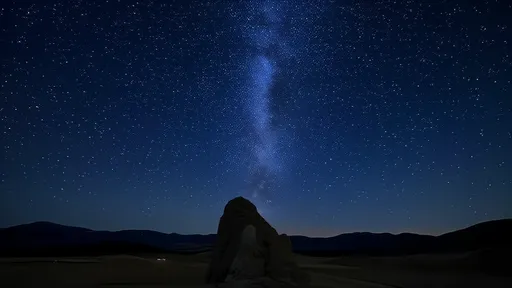
Locations such as the Ngari Prefecture in western Tibet, particularly areas near the sacred Mount Kailash and Lake Manasarovar, are legendary among astronomy enthusiasts. The combination of thin, dry air and virtually non-existent light pollution creates conditions where the Milky Way appears not as a faint smudge but as a brilliant, detailed structure casting discernible shadows on the ground. The sheer number of visible stars can be disorienting to those accustomed to light-polluted skies, revealing a universe teeming with light. Here, one can easily observe the ethereal glow of zodiacal light and the gegenschein, phenomena rarely seen elsewhere.
The Gobi Desert: A Sea of Darkness
Stretching across northern China and southern Mongolia, the Gobi Desert offers a starkly different but equally compelling landscape for night-sky observation. Its defining characteristic is its immense size and profound isolation. Vast, uninhabited expanses ensure that the horizon is devoid of any artificial light sources for hundreds of miles in every direction, creating what astronomers call a "Class 1" or "Bortle Scale 1" sky—the darkest possible rating.
Areas within the Inner Mongolia Autonomous Region, such as the Badain Jaran Desert, provide a stable and dry observing platform. The desert air, while sometimes carrying fine dust, is often exceptionally still, leading to superb "seeing" conditions where stars twinkle minimally and planets appear as steady, sharp discs through a telescope. The emptiness of the landscape amplifies the celestial spectacle, creating a powerful juxtaposition between the barren, silent Earth and the vibrant, star-filled heavens above. Observers here are treated to spectacular views of the summer Milky Way core and, during the winter months, brilliant constellations like Orion dominating the eastern sky.
Mountains of Sichuan and Yunnan: High-Altitude Havens
Southwestern China, with its dramatic topography, hosts several world-class high-altitude observing sites. The provinces of Sichuan and Yunnan are home to mountain ranges whose peaks pierce the stable air layers above, offering superb astronomical seeing. The Yunnan-Guizhou Plateau, with an average elevation of around 2,000 meters, features numerous secluded valleys and high mountain passes that are ideal for setting up a telescope.
The Lijiang area in Yunnan, for instance, is not only a UNESCO World Heritage site for its cultural significance but is also renowned for its clear skies. The Gaomeigu Plateau, historically used for meteorological and astronomical observations, benefits from its southern latitude, granting observers views of celestial wonders invisible from further north, such as the Large and Small Magellanic Clouds—satellite galaxies of our own Milky Way. The dry season, from October to April, provides long stretches of cloud-free nights with exceptional atmospheric stability, making it a premier destination for both visual observers and astrophotographers aiming to capture the southern sky.
Environmental Prerequisites for Optimal Stargazing
Finding a truly dark sky involves more than just traveling to a remote location. Several critical environmental factors must align to create the perfect conditions for observing the cosmos. The most obvious enemy of the astronomer is light pollution, the artificial glow from towns and cities that washes out all but the brightest stars. The ideal site must be situated dozens, if not hundreds, of miles from major population centers. The use of light pollution maps is essential for planning any serious stargazing expedition to ensure one is positioned within a core darkness zone.
Atmospheric transparency is another crucial element. This refers to the clarity of the air and its ability to transmit light without absorption or scattering. Hazy, humid, or polluted air significantly dims starlight and obscures faint nebulae and galaxies. Arid, high-altitude locations naturally excel in this regard, as there are fewer aerosols and water molecules in the air to interfere with incoming light. A night following a cold front passage, when the air is particularly clear and dry, often provides the best transparency.
Astronomical seeing, a term describing the stability of the atmosphere, is paramount for observing fine detail on planets or splitting close double stars. Poor seeing, caused by turbulent air currents, makes stars twinkle violently and causes images in a telescope to blur and boil. The best seeing conditions are typically found at high-elevation sites where the observer is above much of the turbulent lower atmosphere, or in locations with very stable air masses, such as over a calm ocean or a large, flat desert.
Finally, weather and seasonal considerations are vital. A location can have perfect darkness and air quality, but if it is perpetually cloudy, it is useless for stargazing. Researching historical climate data for your chosen destination is imperative. Generally, the dry season in any region will offer more clear nights than the wet, monsoon season. Furthermore, the time of year determines what part of the Milky Way and which constellations are visible overhead. Planning a trip to coincide with both favorable weather and a desired celestial target, like the center of our galaxy in the summer, is the hallmark of a successful stargazing journey.
Venturing to these remote corners of China in search of the perfect night sky is more than a hobby; it is a transformative experience. It requires preparation, patience, and a willingness to embrace the elements. The reward, however, is incomparable: a front-row seat to the greatest show in the universe, a profound sense of perspective, and a memory of the star-drenched heavens that will last a lifetime. As development continues, preserving these fragile dark sky sanctuaries becomes ever more critical, not just for astronomy, but for the human spirit.

By /Aug 22, 2025
By /Aug 22, 2025

By /Aug 22, 2025

By /Aug 22, 2025

By /Aug 22, 2025

By /Aug 22, 2025

By /Aug 22, 2025

By /Aug 22, 2025

By /Aug 22, 2025

By /Aug 22, 2025

By /Aug 22, 2025

By /Aug 22, 2025
By /Aug 22, 2025
By /Aug 22, 2025

By /Aug 22, 2025

By /Aug 22, 2025
By /Aug 22, 2025

By /Aug 22, 2025

By /Aug 22, 2025