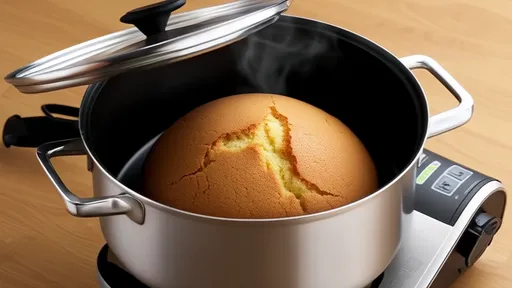
In the quiet hum of a modern kitchen, an unexpected alchemy takes place. The rice cooker, that steadfast sentinel of grains and steam, has been quietly moonlighting as a confectionery wizard. Across countless home kitchens, a curious and delightful trend has taken root: baking a cake not in a traditional oven, but within the familiar stainless-steel bowl of an electric rice cooker. The method is disarmingly simple, yet its success hinges on a single, crucial, and often misunderstood step: after the cook button pops up, you must let it be. You must walk away and allow the residual heat to work its magic for a full twenty-five minutes. This is not a suggestion; it is the secret.
The very idea seems to defy convention. A rice cooker is designed for one purpose, to apply a consistent, moist heat until a specific internal temperature is reached, triggering the thermostat to switch from cook to warm. This mechanism, it turns out, is surprisingly well-suited for the gentle, even baking required for certain types of cakes. Unlike an oven’s fierce, drying radiant heat that can easily scorch the outside while leaving the inside raw, the rice cooker provides a gentler, more enveloping warmth. It’s a steamy, humid environment that mimics a professional convection oven or even a traditional steam-baked pudding. The result is a cake of remarkable tenderness and moisture, one that is notoriously difficult to achieve in a standard home oven without extreme precision.
However, the journey from batter to bliss is a lesson in patience and thermal physics. The moment the switch clicks over to warm is the most critical juncture in the entire process. To lift the lid at this point is to invite disaster—a sunken, gummy, and profoundly disappointing pancake-like substance. The internal structure of the cake at this stage is a fragile network of set protein and gelatinized starch, but it is not yet fully cooked through. The sudden drop in temperature and pressure caused by opening the lid causes that delicate matrix to collapse instantly. The steam, which is still actively cooking the center, escapes, halting the process prematurely. The cake, quite literally, deflates under the shock.
This is where the twenty-five-minute wait becomes non-negotiable. This period of rest is not passive; it is an active phase of carry-over cooking. The thermal mass of the inner pot and the trapped residual heat continue to diffuse gently through the batter. This extended, low-heat application ensures that the very center of the cake sets perfectly without the outside becoming overbaked or tough. It effectively pasteurizes the eggs and flour, making it safe to eat, while transforming the texture from wet and eggy to light and springy. It is the difference between a cooked exterior and a fully, perfectly baked entirety. This principle is well-known in professional cooking—allowing a large roast to rest, for instance—but it is absolutely paramount in the enclosed, precise environment of the rice cooker.
The type of cake batter matters immensely. Dense, heavy batters laden with butter or cream cheese can struggle in this environment, as they require more intense, prolonged heat to set properly. The champions of rice cooker baking are often the simpler, lighter concoctions: classic sponge cakes, chiffons, or even Japanese-style cotton cheesecakes. These rely on whipped egg whites for leavening, creating a structure that is more receptive to the gentle heat. The batter should be pourable but not liquid, offering just enough resistance to the spoon. Overmixing is a common pitfall, as it deflates the incorporated air and leads to a dense result. The goal is to preserve as much of that airy volume as possible, as it will expand beautifully in the steamy confines of the pot.
Preparation of the cooker itself is another subtle art. Simply dumping batter into a plain pot is a recipe for a frustrating cleanup. A light greasing of the bottom and sides is essential, but perhaps the most pro-level tip is to line the bottom with a circle of parchment paper. This small act guarantees a clean release every time, preserving the beautiful golden-brown crust that forms on the bottom. There’s no need to preheat the rice cooker as one would an oven; starting with a cold pot allows for a more gradual and even rise, preventing the bottom from setting too quickly and burning.
The final unveiling is a moment of pure kitchen suspense. After the long wait, the lid is lifted not to a raw mess, but to a domed, golden-brown masterpiece. The initial test is always the skewer; inserted into the center, it should emerge clean, with perhaps a crumb or two, but no wet batter. The true success, however, is revealed in the texture. A perfectly executed rice cooker cake is phenomenally moist, with an even, tender crumb from edge to edge. It lacks the dry crust of an oven-baked cake, instead boasting a soft, velvety exterior. The flavor is often perceived as more intense because it hasn’t been baked out or caramelized; it’s pure, unadulterated cake essence.
This phenomenon is more than a clever kitchen hack; it is a testament to ingenuity and a deeper understanding of how heat interacts with food. It democratizes baking for those without access to a reliable oven, be they university students in dorms, apartment dwellers with inefficient appliances, or anyone simply intrigued by the challenge. It speaks to a global kitchen culture where tools are not limited to their primary function but are reimagined to create joy and community. The shared success stories and occasional hilarious failures in online forums have built a vibrant community of rice cooker bakers, all united by the universal truth of that twenty-five-minute wait. It is a lesson in trust—trust in the process, trust in the machine, and ultimately, trust in the transformative power of patience.
By /Aug 20, 2025
By /Aug 20, 2025
By /Aug 20, 2025

By /Aug 20, 2025
By /Aug 20, 2025
By /Aug 20, 2025
By /Aug 20, 2025
By /Aug 20, 2025
By /Aug 20, 2025
By /Aug 20, 2025
By /Aug 20, 2025
By /Aug 20, 2025

By /Aug 20, 2025
By /Aug 20, 2025

By /Aug 20, 2025
By /Aug 20, 2025

By /Aug 20, 2025
By /Aug 20, 2025

By /Aug 20, 2025
By /Aug 20, 2025